What Is Lumbar Support in Theater Seats? Explained
Table of Contents
- What Is Lumbar Support in Theater Seats?
- How Power Lumbar Support Works in Recliners
- Power Lumbar Support Benefits for Long Viewing Sessions
- Ergonomic Home Theater Seating: What Makes a Chair Actually Comfortable
- Best Home Theater Seating for Back Pain: What to Look For
- Fixed vs. Adjustable Lumbar Support: Which One Fits Your Room?
- Maintenance and Troubleshooting for Power Lumbar Mechanisms
- Conclusion
- Frequently Asked Questions
Last Updated: October 3, 2026
What Is Lumbar Support in Theater Seats?
Lumbar support in theater seats is a built-in cushion or adjustable pad at the lower back that maintains the spine's natural inward curve during long viewing sessions. Without it, the lower back flattens against a flat backrest and your postural muscles work overtime.
Buyers who've owned cheap recliners aren't shopping for fabric swatches, they're shopping for something their back won't punish them for after a three-hour movie.
The Anatomy Behind the Cushion
The lumbar spine is the inward curve between your ribcage and pelvis. In a flat-backed chair, that curve disappears, and the muscles and ligaments around the lower spine stretch to hold you up.
A lumbar cushion or adjustable pad fills that gap, restoring the curve so your skeleton carries the load instead of your muscles. That's why proper lumbar support feels different within minutes, not hours.
How Power Lumbar Support Works in Recliners
Power lumbar support uses a small motor to inflate or extend a pad inside the lower backrest, letting you change support level with a button instead of a pillow.
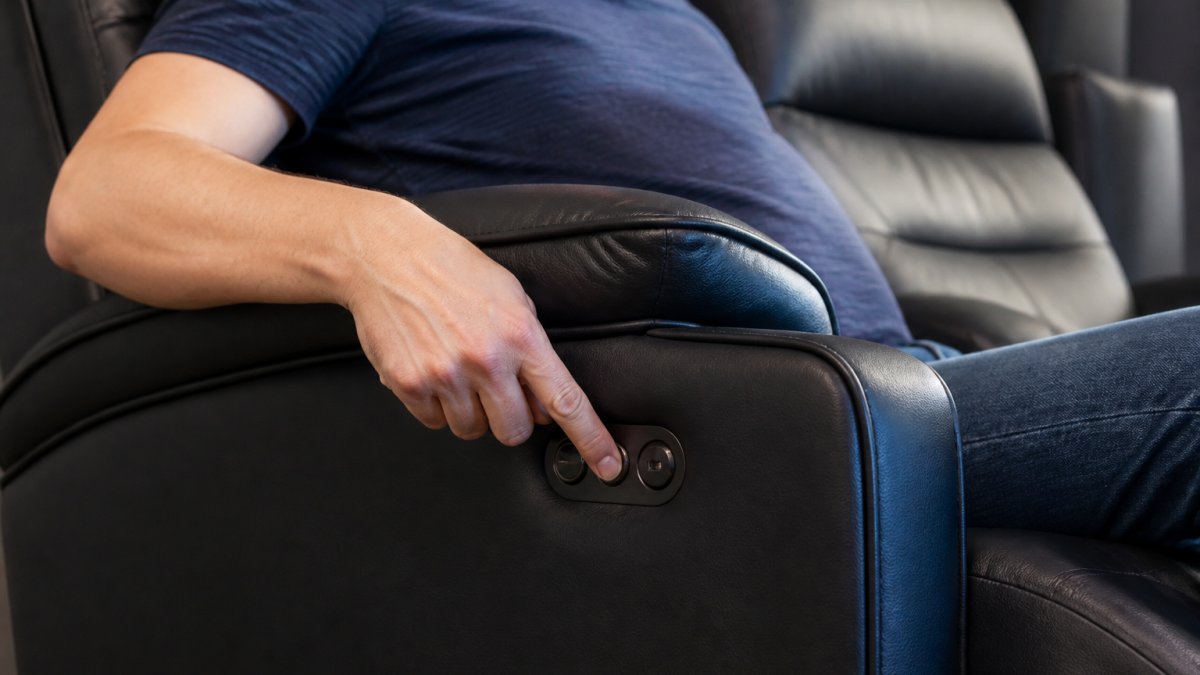
The advantage over a fixed cushion is range.
Power Lumbar Support Benefits for Long Viewing Sessions
The clearest benefit of power lumbar support is that it delays the point where your lower back starts to ache. A double feature runs three to four hours; static seats let discomfort build until, by hour two, you're shifting instead of watching.
Pressure Relief and Posture Correction
Support intensity that changes with your recline angle keeps pressure spread across your back rather than concentrated at one point. That's the difference between a seat you sink into and one you keep adjusting.
That's why best home theater seating for back pain searches skew toward adjustable models. Buyers with lower back strain don't want the softest cushion; they want a seat that holds a position, not one that swallows them.
Ergonomic Home Theater Seating: What Makes a Chair Actually Comfortable
Ergonomic home theater seating is designed around four contact points: the lumbar curve, the neck, the seat depth, and the armrest height. Get all four right and the chair disappears under you; miss one and you'll notice within an hour.
Here's what to check before you buy:
| Feature | What to Look For | Why It Matters |
|---|---|---|
| Lumbar support | Adjustable pad or power control | Matches support to your body type |
| Headrest | Adjustable angle | Keeps the neck neutral at recline |
| Seat depth | Fits thigh length, no edge pressure | Prevents slouching to reach the floor |
| Recline mechanism | Smooth motorized adjustment | Lets you change position without standing |
| Upholstery | Breathable, durable material | Holds shape over years of use |
OSHA's guidance on ergonomic seating and workstation design outlines the same principle for office chairs: adjustability beats padding when a person sits for long stretches.
The Anatomy of Sitting: Why Your Lower Back Needs a Curve
Most theater seating content tells you to buy adjustable lumbar support without explaining why. The reason is mechanical, the same reason physical therapists treat low back pain with posture correction rather than rest.
Your lumbar spine, the five vertebrae between your ribcage and pelvis, has a natural inward curve called lordosis.
A lumbar pad restores the curve. When the inward arch is supported, the load transfers to the vertebrae, discs, and seat back, letting your muscles relax, which is why a properly supported seat feels different within minutes rather than hours.
Why Recline Angle Changes Everything
Here's the part product pages skip: the lumbar curve you need at a 100-degree upright angle is not the curve you need at a 140-degree recline.
This is the mechanical argument for power lumbar support over a fixed cushion: the pad has to travel with your spine's changing position, not sit in one spot. A power mechanism lets you add depth as you recline, the opposite of what most people assume.
Matching Lumbar Support to Your Body Type
Body type determines where the lumbar curve actually sits, the compatibility issue most product pages skip.
- Height: A viewer over 6 feet typically needs the pad higher in the backrest, roughly at the lowest rib, because their lumbar curve sits higher relative to the seat. A viewer under 5'6" usually needs it lower and shallower, or it pushes into the mid-back instead of the lumbar region.
- Weight and torso depth: A deeper torso needs more pad travel to reach the spine. A shallow pad on a deep torso leaves a gap; a deep pad on a shallow torso creates pressure points.
- Seat depth interaction: If the seat pan is too deep, you'll slide forward to reach a comfortable knee angle, pulling your lumbar curve away from the pad. Seat depth and lumbar position must be tuned together.
A power lumbar mechanism solves most of this because the pad moves to you; a fixed cushion only works if your proportions match the seat's design. If you're outside the manufacturer's average, adjustable support is the difference between using the chair and avoiding it.
The Four Contact Points, In Order of Priority
If you can only evaluate a few things, rank them this way:
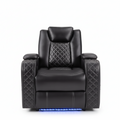
Ridgeline Single Power Theater Recliner →
- Lumbar adjustability, the single highest-impact feature for long sessions.
- Seat depth fit, wrong depth undermines even good lumbar support.
- Headrest angle, matters most at full recline, where neck strain replaces back strain.
- Armrest height, should let your shoulders drop and your forearms rest level.
Upholstery and cup holders don't affect whether your back hurts at hour three, treat them as secondary specs.
Best Home Theater Seating for Back Pain: What to Look For
For back pain, prioritize adjustable lumbar support, an adjustable headrest, and a recline mechanism that changes angle without straining. Fixed support can work, but it can't adapt as your position changes.
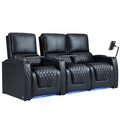
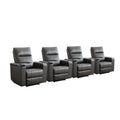
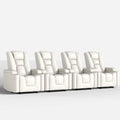
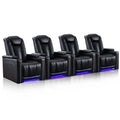
We carry the Ridgeline Single Power Theater Recliner, a single seat with power recline and a built-in cup holder. For a full room, the Ridgeline 4-Seat Power Recliner Set comes in gray, beige, black, or brown, so the seating matches the room instead of fighting it.


If you want everything within reach, the Ridgeline Power Recliner with USB & Storage Arm adds USB charging, dual cup holders, and a storage arm for remotes.

Fixed vs. Adjustable Lumbar Support: Which One Fits Your Room?
Fixed lumbar support suits a single dedicated viewer whose proportions match the seat, and it costs less. Adjustable support suits shared rooms, mixed body types, and anyone who reclines through a long session. Most buyers get this wrong the same way, they buy fixed support for a shared room and then wonder why half the family avoids the seats.
When Fixed Lumbar Support Is the Right Call
Fixed support makes sense in three specific situations:
- One primary viewer, known proportions. If one person uses the chair 90% of the time and their height and torso depth match the seat's design, a fixed pad can be perfectly comfortable.
- Budget-constrained single-seat purchase. A fixed-lumbar recliner typically costs less than a comparable power-lumbar model, and for one person that savings is real.
- Secondary seating. A fixed-lumbar chair in a guest room or rarely-used second row is fine, the viewer isn't logging three-hour sessions in it.
When Adjustable Lumbar Support Is the Right Call
Adjustable support is the better choice in almost every other scenario, and the reasons are concrete:
- Shared seating. Five people of different heights sharing one row of fixed seats means four sit in a chair built for someone else. A 5'4" viewer and a 6'2" viewer need the pad in different positions, no fixed shape serves both.
- Long sessions. A double feature runs three to four hours, and most viewers change recline angle at least once. A fixed pad that fits upright leaves a gap at full recline, and the gap is where the ache starts.
- Existing back issues. If anyone in the household deals with lower back strain, adjustable support determines whether the chair gets used.
The Body-Type Test Before You Buy
You can evaluate any theater chair against your own body in about two minutes:
- Sit at full recline, not upright. This is the position that matters.
- Slide your hand into the gap between your lower back and the seat back. If your hand fits easily, the pad isn't reaching your lumbar curve. If you feel pressure at the top of your pelvis or mid-back instead of the lower back, the pad is positioned wrong for your height.
- Hold for two minutes. If you're already shifting, the support isn't right for a three-hour session.
If the chair has power lumbar, repeat the test with the pad extended. The difference between the two positions is the range you're paying for.
The Cost Trade-Off, Honestly Stated
Adjustable lumbar support adds cost because it adds a motor, a control, and a pad mechanism, a real premium over a fixed cushion. The question isn't whether adjustable costs more, but whether the fixed option fits the people who will sit in it.
A fixed-lumbar chair that fits one viewer well beats an adjustable chair that fits no one, but a fixed-lumbar chair shared by a family of mixed heights is one half the household will avoid.
Maintenance and Troubleshooting for Power Lumbar Mechanisms
Power lumbar mechanisms are simple: a motor, a control, and a pad. Most failures trace back to the power supply, not the motor.
- Pad won't inflate: check the power connection and the control panel before assuming the motor failed.
- Slow or uneven movement: the mechanism may be binding; stop using it and contact the retailer rather than forcing it.
- No response at all: test whether the recline function still works. If recline works and lumbar doesn't, the fault is isolated to the lumbar motor or its wiring.
Consumer Product Safety Commission guidance on product registration and recalls is worth checking for any powered furniture, since registering your purchase is how you get notified if a component is ever recalled.
Never force a stuck lumbar pad by hand. The motor and the pad are linked, and pushing against a jammed mechanism can strip the linkage and turn a warranty repair into a replacement.
Conclusion
The gap between a theater seat you love and one you tolerate usually comes down to one feature: whether the lower back gets support that adapts to you. Fixed cushions work for some bodies.
At JoeMo Promo, we stock Ridgeline power recliners with power recline, cup holders, and options like USB charging and storage arms, plus free shipping on most orders within the Continental U.S. and a 30-day return policy.
Frequently Asked Questions
Why is lumbar support important in theater seating?
Lumbar support maintains the natural inward curve of your lower spine, called lumbar curvature. Without it, your back flattens against a flat seat back, which strains muscles and discs over a two-hour movie. A built-in cushion or adjustable pad fills that gap so your back stays in a neutral position, reducing lower back strain and letting you stay comfortable through a full viewing session.
How does power lumbar support work in recliners?
A motorized air bladder or mechanical pad sits inside the lower backrest. You press a button on the chair's control panel, and the mechanism expands or retracts to change how much support intensity you feel. This is the same motorized adjustment concept used in car seats. Most power recliners let you fine-tune the lumbar bulge independently of the recline angle, so you can dial in support as your seating position changes.
Is adjustable lumbar support worth the extra cost?
Adjustable lumbar support usually adds a few hundred dollars to a theater chair's price. It is worth it if more than one person uses the seat or if you switch between sitting upright for sports and reclining for movies. Fixed support works fine for a single user who always sits the same way. If you have existing lower back issues, the ability to change support intensity as your back tires during a long session is a practical upgrade, not a luxury.
What is the difference between fixed and powered lumbar support?
Fixed lumbar support is a shaped foam or padding built permanently into the backrest contour. It provides the same level of support every time you sit down. Powered lumbar support uses a motor to inflate or move a pad, so you can increase or decrease the bulge with a button. Fixed costs less and has nothing to break. Powered lets you customize settings per person and adjust mid-movie without getting up.