Surround Sound Alternatives for Apartments: 5 Options
Table of Contents
- Why Apartments Need Different Audio Solutions
- Quick Comparison: Surround Sound Alternatives for Apartments
- The Best Soundbar for Apartment Living
- Virtual Surround Sound: Big Audio from Small Speakers
- Compact Stereo Speakers for TV: A Space-Saving Option
- Wireless Headphones for TV: Private Listening That Works
- Compact Surround Systems That Fit Apartment Spaces
- Conclusion
- Frequently Asked Questions
Last Updated: October 18, 2026
Why Apartments Need Different Audio Solutions
Apartment living changes the audio equation. You are dealing with shared walls, a lease that limits wall damage, and neighbors who notice every bass note. A traditional five-speaker-plus-subwoofer rig that sounds fantastic in a detached house often creates three problems in a rental: installation you cannot undo, floor space you cannot spare, and sound that travels through the building structure.
The good news is that the surround sound alternatives for apartments on the market now deliver genuine immersion without any of that. At JoeMo Promo, we help renters and small-space owners build cinema-grade setups that pack down, plug in, and stay on good terms with the neighbors.

Here is what most guides get wrong: they treat apartment audio as a compromise. It is not. It is a different set of priorities, and once you match the gear to those priorities, you get a better result than a full-size system crammed into a room it was never designed for.
Quick Comparison: Surround Sound Alternatives for Apartments
The table below summarizes the five main surround sound alternatives, what each does best, and roughly how much floor space it commits you to.

| Option | Space Needed | Setup Effort | Best For | Typical Cost Range |
|---|---|---|---|---|
| Soundbar (with or without sub) | One shelf or wall mount | Very low | Renters who want one-cable simplicity | Budget to mid-range |
| Virtual surround system | Small footprint, front only | Low | Small rooms with no rear-speaker room | Mid-range |
| Compact stereo speakers | Two small stands or a shelf | Low | Music-first listeners and dialogue clarity | Budget to mid-range |
| Wireless TV headphones | None (personal) | Very low | Late-night viewing and shared households | Budget |
| Compact 5.1 system | Small satellites, one sub | Moderate | Movie fans who want true rear channels | Mid to upper |
The trade-off is consistent across all five: the more physical speakers you place around the room, the more convincing the rear-channel effect. The fewer speakers, the more you rely on processing tricks. Neither approach is wrong. It depends on how much space and setup tolerance you have.
The Best Soundbar for Apartment Living
The best soundbar for apartment living is a single-unit or soundbar-plus-subwoofer design that sits under the TV, needs one power outlet and one audio cable, and offers a night mode that compresses loud explosions without muting dialogue. It is the lowest-friction way to upgrade TV audio in a rental.
Why it wins in apartments: nothing gets mounted to a wall you do not own, nothing sits behind the couch where it will be kicked, and you can unplug the whole thing in under a minute when you move. A soundbar also directs sound forward rather than downward into the floor, which matters when your downstairs neighbor shares your ceiling.
Two things to check before buying:
- Does it decode surround formats, or just play stereo? Many budget bars simulate width but never produce a true rear effect.
- Does it have a dedicated night or dialogue mode? This is the feature apartment dwellers actually use most.
The honest limitation: a single bar cannot place sound behind you. If rear-channel immersion is the goal, read the next section.
Virtual Surround Sound: Big Audio from Small Speakers
Virtual surround sound is a processing technique that uses two or a few front-facing speakers and psychoacoustic filtering to create the impression of sound arriving from behind and beside you. It is not a physical speaker array. It is a convincing illusion, and in a small room it works better than most people expect.
The appeal for renters is obvious. You get a wider, taller soundstage from a bar or a compact system with no rear speakers to place, cable, or explain to a landlord. Setup is usually a single HDMI connection.
Where it falls short: the effect depends on your seating position. Sit off-center and the illusion weakens. Rooms with hard floors and bare walls also smear the effect through reflections, so a rug and a bookshelf do more for virtual surround than most people realize.
Compact Stereo Speakers for TV: A Space-Saving Option
Compact stereo speakers for TV are a pair of powered bookshelf-style speakers connected directly to your television, delivering clean two-channel audio with far better dialogue clarity than any built-in TV speaker. They take up roughly the footprint of two coffee mugs.
This is the option we recommend most often to people who watch a mix of movies, sports, and music. A good stereo pair images surprisingly well: sounds pan left to right convincingly, and dialogue sits firmly in the center. What you give up is the discrete rear channel.
Placement matters more than price here. Put the speakers at ear height, angled slightly inward, and keep them off the same surface as the turntable or anything that rattles.
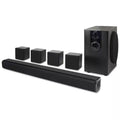
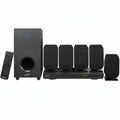
iLive 5.1 Surround Sound System →
- Best for: music listeners, dialogue-heavy drama, small rooms under 200 square feet
- Skip if: you specifically want sounds behind your head during action scenes
- Watch out for: speakers placed too close together, which collapses the stereo image into mono
Wireless Headphones for TV: Private Listening That Works
Wireless headphones for TV solve the apartment audio problem completely: no sound leaves your head, so no neighbor hears anything. Modern TV headphones connect through a base station that plugs into your TV's optical or HDMI output, which avoids the Bluetooth lag that makes lip-sync unwatchable.
This is the option nobody talks about enough. For a single viewer in a thin-walled building, it is the highest-quality-per-dollar path to immersive audio, because headphone surround processing is genuinely convincing and you can listen at reference volume at 2 a.m.
The catch is social. Headphones are a solo experience, so they work for late-night viewing and not for movie night with four friends. Many households run both: a soundbar for group viewing, headphones for after everyone else goes to bed.
Compact Surround Systems That Fit Apartment Spaces
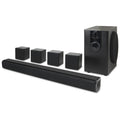
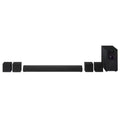
Compact 5.1 systems shrink the traditional home theater into satellites the size of a coffee cup and a subwoofer you can tuck beside the sofa. They are the only option on this list that produces real rear channels from real speakers, and modern compact kits are small enough to sit on floating shelves or slim stands without dominating the room.
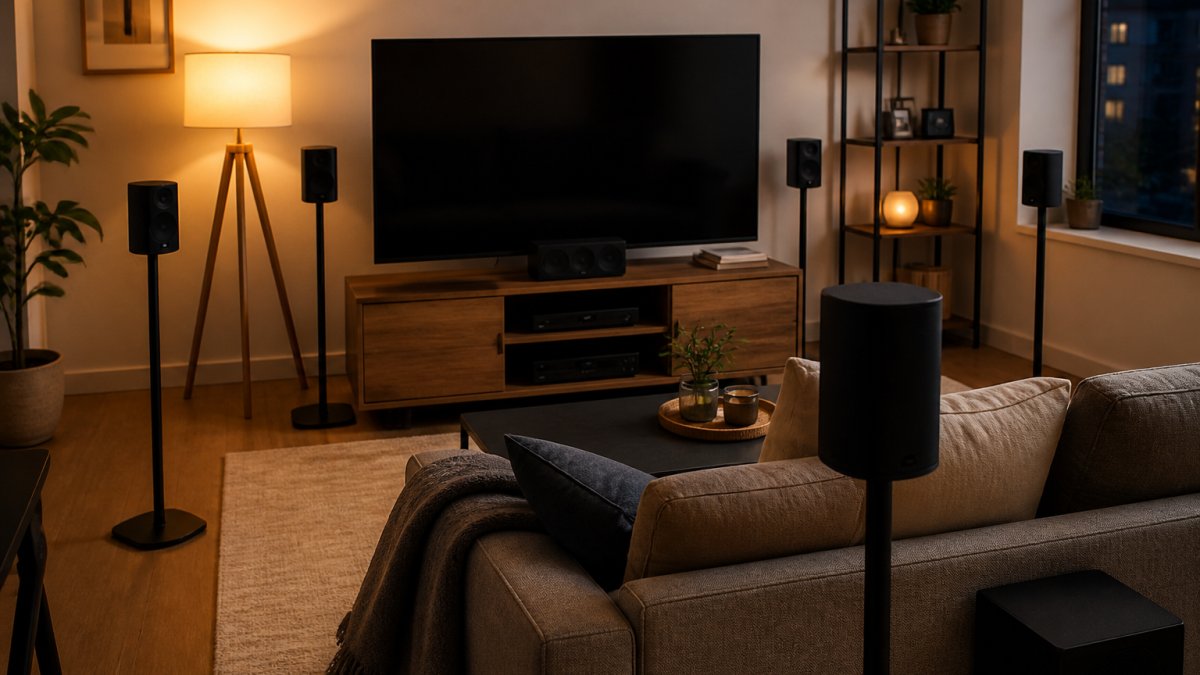
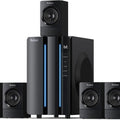
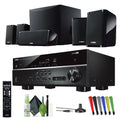
This is where our own catalog does the most work. The iLive 5.1 Surround Sound System pairs over Bluetooth with your TV or streaming box and sets up plug-and-play, with no separate receiver to configure. If budget is the deciding factor, the JoeMo 800W Surround Sound System brings a 6.5-inch subwoofer and built-in EQ modes for under $200. For a step up in amplification, the Yamaha YHT-4950U 5.1 Home Theater System delivers 400W across five channels.

The practical constraint in an apartment is the subwoofer, not the satellites. Bass travels through floors. Put the sub on a isolation pad or a scrap of dense foam, keep it off the wall, and dial the crossover down. Your downstairs neighbor will thank you.
If you want the fullest front stage without a receiver, the iLive Cinema Series 5.1 Speaker System uses a 26-inch center speaker to anchor dialogue. And for households tired of juggling remotes, the iLive Home Theater System with Learning Remote puts the whole setup, TV included, on one clicker.
Conclusion
The hardest part of apartment audio is not picking a system. It is accepting that your room, your lease, and your neighbors are part of the spec sheet. Once you build around those constraints, the result sounds better than a full-size rig fighting a space it does not fit.
Start with how you actually watch: solo late at night, or a room full of people on game day. That answer points to headphones, a soundbar, or a compact 5.1 kit. JoeMo Promo stocks all three paths, with free shipping on most orders within the Continental U.S. and a 30-day return policy if the room disagrees with you.
Frequently Asked Questions
What is the best alternative to surround sound in an apartment?
A soundbar is the most practical alternative for most apartments. It sits under or in front of the TV, takes up almost no floor space, and delivers clear dialogue plus simulated surround effects without rear speakers. If you want more separation, a compact 5.1 system like the iLive 5.1 Surround Sound System at $519.99 gives you real rear channels while still fitting a small room. For late-night viewing, wireless headphones for TV keep the sound entirely private.
Is a soundbar better than surround sound for an apartment?
For apartments, a soundbar usually wins on space and simplicity. It requires no rear speaker placement, no cable runs across the floor, and no mounting. A traditional surround system can sound more immersive, but it needs room behind the seating position and careful volume control to avoid bothering neighbors. If your living room is under 200 square feet, a soundbar or virtual surround sound setup is the lower-risk choice.
Can headphones create a surround sound experience for movies?
Yes. Many wireless headphones for TV include virtual surround sound processing that simulates rear and height channels through two earcups. The effect is convincing for movies and games, and it keeps all audio private, which solves neighbor noise completely. Look for headphones with low-latency wireless transmission to avoid lip-sync issues. They are also the best option for watching late at night without disturbing anyone in the next room.
How can I get immersive TV sound without disturbing my neighbors?
Start with a soundbar or compact stereo speakers for TV and keep the subwoofer on a isolation pad or a low shelf. Use night mode or dynamic range compression if your system offers it, which tames explosions while keeping dialogue clear. Wireless headphones for TV are the surest way to stay quiet after 10 p.m. Virtual surround sound in a soundbar also helps because the effect relies on processing rather than high volume.
Can a subwoofer be used in an apartment without bothering neighbors?
A subwoofer can work in an apartment if you place it on a dense foam pad or a dedicated isolation platform, keep it off shared walls, and avoid corner placement where bass builds up. Smaller subwoofers with front-firing drivers are easier to control in tight rooms. Many compact systems, like the JoeMo 800W Surround Sound System at $198.24, include a 6.5-inch subwoofer that delivers punch without the output of a large floor-standing unit.
Ready to stop compromising on movie night? Browse the JoeMo Promo home theater collection and find the compact system that fits your space, your lease, and your neighbors.