Portable Projector Alternatives for Outdoor Movies
Table of Contents
- Why Portable Projectors Still Win for Backyard Cinema
- Outdoor Movie Screen Alternatives That Beat a Bedsheet
- Using a TV for Outdoor Movie Night: When It Works
- DIY Outdoor Movie Screen Ideas Under $50
- Top Portable Projector Picks for Outdoor Movies
- Powering Your Setup Off-Grid
- Ambient Light and Audio Sync: The Two Problems Nobody Warns You About
- Conclusion
- Frequently Asked Questions
Last Updated: October 20, 2026
Why Portable Projectors Still Win for Backyard Cinema
A portable projector remains the simplest path to a backyard movie night because it turns any flat surface into a screen and packs away in minutes. The screen, the power, and the light are.
Below, we'll show you exactly how to fix all three, plus the alternatives worth considering when a projector alone won't cut it.
Here's the part most guides get wrong. They treat "portable projector alternatives for outdoor movies" as a shopping question about screens. It isn't. The real constraint is ambient light. A projector rated for a dark room will look washed out at 8pm in June no matter what you project onto. Get the light right and a modest projector looks great.
That's the throughline for everything that follows: match your gear to your light, your power, and your audio, in that order.
Outdoor Movie Screen Alternatives That Beat a Bedsheet
A bedsheet is the default first attempt, and it's the worst option on the list. Fabric wrinkles, sags, and lets light pass straight through, which kills contrast and color accuracy.
Inflatable projection screens are the easiest upgrade. They inflate in minutes, hold a taut surface, and many include a built-in blower.
Fixed-frame outdoor screens give the best image clarity because the surface stays perfectly flat. They're a permanent install, so they suit a dedicated backyard cinema rather than a occasional setup.
Pull-down and tripod screens sit in the middle: portable enough to store, taut enough to avoid wrinkles, and available in sizes that pair well with a portable projector.
The one thing all three share is a matte, non-reflective surface. That's the property that matters.
Using a TV for Outdoor Movie Night: When It Works
An outdoor TV is the right call in exactly one scenario: a covered patio with a permanent mount and a nearby outlet.
Everywhere else, it loses. Outdoor-rated televisions cost far more than a portable projector, they're heavy, and they don't move. If your movie night migrates between the patio, the lawn, and the garage, a TV is the wrong tool.
There's also a durability question. Electronics left outside face humidity and temperature swings, and even weather-rated models need protection. For occasional backyard use, the portability and low setup time of a projector win.
Our take: buy a TV only if the location never changes and the patio is covered. Otherwise, put the money into a brighter projector and a proper screen.
DIY Outdoor Movie Screen Ideas Under $50
A DIY screen is a weekend project, not a compromise. The goal is a flat, matte, light-colored surface with no wrinkles and no light bleed.
- Canvas drop cloth + PVC frame: Stretch a 9x12 canvas drop cloth over a frame built from PVC pipe and corner fittings. Tension it evenly; staples or bungee cords work.
- Blackout cloth on a garage door: Blackout fabric is opaque and matte. Hang it with clips and you have a screen in five minutes.
- White shower curtain liner: Cheap, wide, and wrinkle-resistant if you steam it first. Best for small yards.
- Foam board panels: Rigid, perfectly flat, and excellent for smaller images. Tape the seams and paint them matte white.
Skip anything glossy, anything with a pattern, and anything that isn't tensioned. Wrinkles show up as shadows on the image, and no amount of keystone correction fixes them.
Top Portable Projector Picks for Outdoor Movies
The best portable projector for outdoor movies balances brightness, native resolution, and setup speed, but "best" depends on your yard. A projector that wins in a pitch-black field loses on a patio with porch lights.
How to read the specs that actually matter outdoors:
- Brightness (lumens): This is the single biggest lever. As a working rule, a dim yard after full dark needs roughly 2,000-3,000 lumens for a 100-inch image; a yard with streetlight spill or twilight screenings needs 5,000+; a covered patio with daylight bleed needs 10,000+. Manufacturers quote peak lumens, so treat the number as a ceiling, not a guarantee.
- Native resolution: Look for the word "native." A projector that says "1080p supported" but "native 720p" is downscaling. Native 1080p is the practical floor for a 100-inch-plus outdoor image; 4K support is a bonus, not a substitute for native resolution.
- Throw ratio: This determines how far back the projector sits for a given screen size. A short-throw unit (roughly 0.5:1) fills a 100-inch screen from about 4 feet; a standard throw (roughly 1.5:1) needs about 12 feet. Measure your yard before you buy, a long-throw projector in a shallow patio is unusable.
- Battery vs. corded: Built-in batteries rarely last a full two-hour film at high brightness. If the unit is corded, plan the power run (see the off-grid section below).
- Audio out: Bluetooth is convenient but adds latency; HDMI ARC or a wired 3.5mm output is the reliable path for external speakers.
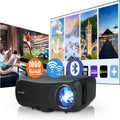
1. Karnstar Outdoor Cinema Projector, $499.99. Our top pick for backyard use.

2. CAIWEI Halo 300 Ultra-Bright Projector, $559.99. The pick if your yard never gets fully dark.
Wanderlight Portable Smart Projector →
3. Nova 300 Smart Home Theater Projector, $529.99. The most forgiving setup. Auto-focus and keystone correction lock in a sharp picture in seconds, and the 360° stand points at a wall, a ceiling, or a bedsheet.
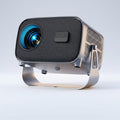
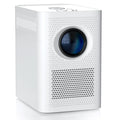
4. Wanderlight Portable Smart Projector, $509.99. The most portable of the group. Smart TV built in, WiFi connected, and small enough to move from the living room to the campsite without a second thought.
| Projector | Price | Best For | Standout Feature |
|---|---|---|---|
| Karnstar Outdoor Cinema | $499.99 | Backyard movie nights | 18,000 lumens, 200" screen included |
| CAIWEI Halo 300 | $559.99 | Yards with ambient light | 10,000 lumens, built-in Android |
| Nova 300 Smart | $529.99 | Fast, fuss-free setup | Auto-focus, keystone, 360° stand |
| Wanderlight Portable | $509.99 | Travel and small spaces | Compact, smart TV built in |
Powering Your Setup Off-Grid
Running an extension cord across a wet lawn is the most common safety mistake in backyard cinema. If your setup isn't near an outlet, plan the power before you plan the movie, and plan it in watt-hours, not vibes.
Step 1: Add up your load. Check the rated wattage on each device's label or spec sheet. A typical portable projector draws 100-300 watts; a soundbar or powered speaker adds 30-100 watts; an inflatable screen blower adds 100-200 watts.
Step 2: Size the battery with headroom. Portable power stations are rated in watt-hours (Wh).
Step 3: Match the output type. Projectors and speakers run on standard AC outlets, so confirm the station's AC output wattage exceeds your total load.
Off-grid options, from simplest to most independent:
- Portable power station (lithium-ion): The cleanest answer for a backyard or campsite. Recharge from a wall outlet before the event, carry it out, plug in. No fumes, no noise, no cord across the grass.
- Solar generator (panel + station): A power station paired with a folding solar panel. Useful for multi-day campouts, but plan for panel wattage and sun hours, a 200W panel in good sun produces roughly 100-140 Wh per hour in real-world conditions, so a full recharge takes most of a day. Don't count on solar to top up mid-film.
- Inverter generator: Higher capacity for larger events, but it's loud and produces exhaust. Keep it well away from the viewing area, route cables where nobody walks, and never run it in an enclosed space.
- Weatherproof outdoor outlet: For a permanent patio, this removes the problem entirely. Have a licensed electrician install a GFCI-protected outdoor circuit.
Runtime reality check: Manufacturer battery ratings are measured under ideal conditions. Cold evenings, high brightness, and simultaneous speaker draw all cut runtime.
Ambient Light and Audio Sync: The Two Problems Nobody Warns You About
Ambient light is the number one killer of outdoor image quality, and audio lag is the number two complaint. Both have straightforward fixes.
For light: wait for full dark, point the projector away from streetlights and porch fixtures, and use a matte screen. If you can't wait, a higher-lumen projector is the only real answer. Contrast ratio drops fast as ambient light rises, and no screen fixes that.
For audio: Bluetooth adds latency, and lip-sync drift is the tell. Many projectors include an audio delay or lip-sync adjustment in settings; nudge it until voices match mouths. Wired HDMI audio avoids the problem entirely. If you're pairing wireless speakers, keep the projector and speakers on the same network band and away from a crowded router.
Conclusion
The hardest part of an outdoor movie night isn't choosing a projector. It's matching the projector to your light, your power, and your audio before the first guest arrives. Get those three right and the rest is easy.
At JoeMo Promo, we've built our projector lineup around exactly that problem. The Karnstar Outdoor Cinema Projector ships with a 200-inch screen and 18,000 lumens for evening light, while the Nova 300 adds auto-focus, keystone correction, and a 360° stand for a setup that takes seconds. Every order includes free shipping on most orders within the Continental U.S. and a 30-day return policy, so you can test the whole setup in your own yard.

Shop the collection and turn your backyard into a theater this weekend.
Frequently Asked Questions
How can I do an outdoor movie without a projector?
You can use a large TV, a laptop or tablet with a group, or even a bright LED wall. For a true big-screen feel, a DIY outdoor movie screen paired with a high-lumen portable projector is the most practical route. If you skip the projector entirely, a TV works for small groups, but you'll need an extension cord and a weather-safe spot.
What is the best portable projector for watching outdoor movies?
Look for at least 3,000 lumens, native 1080p resolution, and built-in streaming apps. The Karnstar Outdoor Cinema Projector ($499.99) delivers 18,000 lumens and includes a 200-inch screen, making it a strong outdoor pick. The Nova 300 Smart Home Theater Projector ($529.99) adds auto-focus and keystone correction for quick setup on uneven surfaces.
Can you use a regular TV for outdoor movie night?
Yes, but with caveats. A regular TV is limited by size, power needs, and weather exposure. You'll need an outdoor-rated extension cord and a covered area. For groups larger than 10, a TV won't match the immersive feel of a portable projector. If you already own a large TV, it can work for a small backyard gathering, but a projector gives you a 200-inch or larger image without hauling furniture outside.
What can I use as an outdoor movie screen?
You can use a white bedsheet, a blackout curtain, a painted wall, or a dedicated inflatable screen. For a DIY outdoor movie screen, stretch a white sheet tightly between two poles and anchor it with stakes. Avoid textured or off-white fabrics, which dull the image. A purpose-built screen like the one included with the Karnstar projector gives you better contrast and a flatter surface.
Is a portable projector or a TV better for outdoor movies?
A portable projector is better for most outdoor movie setups because it scales to 200 inches or more, runs on standard power or a portable power bank, and is easy to store. A TV is brighter in daylight but limited in size and harder to move. For evening screenings, a projector like the CAIWEI Halo 300 ($559.99) with 10,000 lumens handles ambient light well and streams via built-in Android.