Best Luxury Theater Seating for Small Rooms 2026
Table of Contents
- Quick Comparison: Luxury Theater Seating for Small Rooms
- How We Chose These Seats (Selection Criteria)
- Wall-Hugger Theater Recliners: The Small-Room Secret
-
Top Luxury Theater Seating Picks for Small Rooms
- 1. Ridgeline Single Power Theater Recliner, Best Solo Seat ($1,519.99)
- 2. Ridgeline Power Recliner with USB & Storage Arm, Best for Tech Users ($1,739.99)
- 3. Ridgeline 4-Seat Power Recliner Set, Best for Families ($1,369.99)
- 4. Ridgeline 5-Seat Power Theater Recliner Set, Best for Dedicated Media Rooms ($1,939.99)
- 5. Haiylee Zero Gravity Theater Sofa, Best for Ultimate Comfort ($2,474.54)
- Home Theater Layout for Small Rooms: Sightlines, Clearance, and Rows
- Compact Home Theater Furniture: Features That Actually Matter
- Which Seat Should You Pick? A Decision Framework
- Conclusion
Last Updated: August 22, 2026
Most guides to luxury theater seating assume you have space to burn. You don't. Fitting real, high-quality recliners into a compact media room is an architectural puzzle, and getting it wrong means seats you can't fully recline or a room you can't walk through. At JoeMo Promo, we've tested and handpicked every seat in this guide specifically for rooms where square footage is the constraint. Below, you'll find the five best options, a layout framework for tight spaces, and a decision tool to match the right seat to your exact situation.
The single most important insight: wall-hugger theater recliners solve the space problem that stops most small-room setups cold. A standard recliner needs 12-18 inches of clearance behind it to recline fully. A wall-hugger mechanism slides the seat forward as it reclines, cutting that clearance requirement to as little as 3-4 inches.
Quick Comparison: Luxury Theater Seating for Small Rooms
| Seat | Price | Seats | Best For | Key Feature |
|---|---|---|---|---|
| Ridgeline Single Power Recliner | $1,519.99 | 1 | Solo upgrade or flex space | Faux leather, power recline, cup holder |
| Ridgeline USB & Storage Arm | $1,739.99 | 1 | Tech-forward setups | USB charging, dual cup holders, storage arm |
| Ridgeline 4-Seat Power Set | $1,369.99 | 4 | Family media rooms | 4 colors, individual power recline |
| Ridgeline 5-Seat Power Set | $1,939.99 | 5 | Dedicated home cinemas | Vegan leather, individual cup holders |
| Haiylee Zero Gravity Sofa | $2,474.54 | 2-3 | Ultimate comfort, primary media room | Top-grain leather, power headrest and footrest |
Quick Picks:

- Best Solo Seat: Ridgeline Single Power Recliner, compact footprint, real theater feel
- Best for Tech Users: Ridgeline USB & Storage Arm, charging and storage built into the armrest
- Best for Families: Ridgeline 4-Seat Set, four individual recliners at the lowest per-seat price
- Best for Dedicated Rooms: Ridgeline 5-Seat Set, full vegan leather row for the whole crew
- Best for Ultimate Comfort: Haiylee Zero Gravity Sofa, zero-gravity recline in top-grain leather
How We Chose These Seats (Selection Criteria)
Luxury theater seating for small rooms demands a different evaluation lens than standard furniture shopping. The criteria that matter: footprint and recline clearance (anything requiring more than 6 inches of wall clearance was deprioritized), power recline, ergonomic support, built-in accessories, upholstery durability, and configuration flexibility. Every seat in this guide meets a minimum threshold on all six criteria.
Wall-Hugger Theater Recliners: The Small-Room Secret
Wall-hugger theater recliners are the single most practical solution for compact home cinema setups. The recline mechanism slides the seat body forward as the back lowers, meaning the chair never extends behind its original position. This lets you place a fully reclining theater chair within a few inches of the back wall.
Most small rooms lose 15-20 inches of usable depth with a standard recliner. In a room that's only 12 feet deep, that's a significant fraction of your total viewing distance. A wall-hugger mechanism gives that depth back. According to ergonomics research published by the Human Factors and Ergonomics Society, seating that supports a reclined position reduces spinal load significantly compared to upright sitting.
Top Luxury Theater Seating Picks for Small Rooms
The five seats below represent the best luxury theater seating options for compact and dedicated media rooms available through JoeMo Promo.
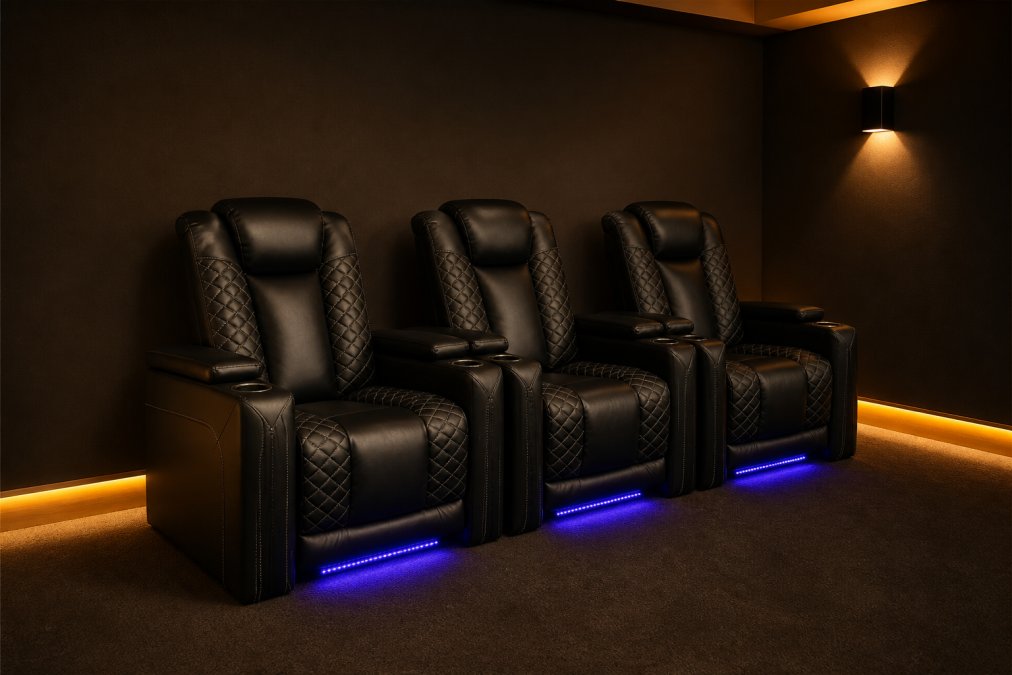
1. Ridgeline Single Power Theater Recliner, Best Solo Seat ($1,519.99)
The Ridgeline Single Power Recliner is the right starting point for anyone adding a first premium seat or upgrading a single position in a mixed-furniture room. One seat, power recline, built-in cup holder, faux leather upholstery. What makes it work in small rooms is the individual seat format, you're not locked into a fixed sectional configuration. Place it solo in a corner media setup, pair it with a second unit later, or mix it with other Ridgeline seats for a custom row.
Best for: Solo viewers, apartment setups, or anyone who wants to test a single premium seat before committing to a full row.
Shop the Ridgeline Single Power Theater Recliner
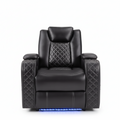
2. Ridgeline Power Recliner with USB & Storage Arm, Best for Tech Users ($1,739.99)
Everything the standard Ridgeline does, plus USB charging, dual cup holders, and a storage arm that holds remotes, phones, and snacks without requiring a side table. The storage arm solves a real layout problem in small media rooms: side tables eat floor space and create walkway obstacles.
Best for: Tech-forward setups, anyone who charges devices during viewing, rooms where floor space is too tight for side furniture.
Shop the Ridgeline USB & Storage Arm Recliner

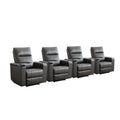
3. Ridgeline 4-Seat Power Recliner Set, Best for Families ($1,369.99)
Four individual power recliners, four cup holders, four color options (gray, beige, black, or brown). At $1,369.99 for the set, this is the lowest per-seat price in the lineup. The individual seat format means you can arrange the four seats in a straight row, a slight arc, or split them into two pairs depending on your room's shape.
Shop the Ridgeline 4-Seat Power Recliner Set
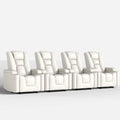
4. Ridgeline 5-Seat Power Theater Recliner Set, Best for Dedicated Media Rooms ($1,939.99)
Five individual vegan leather power recliners, each with its own cup holder. The vegan leather upholstery is a step up in both look and feel from standard faux leather and holds up well to regular use. Each seat reclines independently, so one person can go flat while another stays upright.
Best for: Dedicated home cinemas, basement theater rooms, households that regularly host movie nights or sports viewing.
Shop the Ridgeline 5-Seat Power Theater Recliner Set
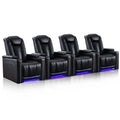
5. Haiylee Zero Gravity Theater Sofa, Best for Ultimate Comfort ($2,474.54)
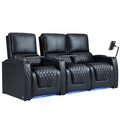
The Haiylee Zero Gravity Theater Sofa uses top-grain leather, a solid-and-engineered wood frame, and independent power controls for both the headrest and footrest. The zero-gravity recline position distributes body weight evenly across the seat, which is meaningfully different from a standard flat recline. For long viewing sessions, that difference matters. The trade-off is footprint: the Haiylee is a sofa-format piece, which means less configuration flexibility than individual Ridgeline seats.
Best for: Primary media rooms, master bedroom setups, anyone prioritizing maximum comfort over seating capacity.
Shop the Haiylee Zero Gravity Theater Sofa

Home Theater Layout for Small Rooms: Sightlines, Clearance, and Rows
Getting the layout right is more important than the seats themselves. The best luxury theater seating performs poorly if sightlines are blocked, viewing distance is wrong, or walkway clearance forces people to squeeze past each other.
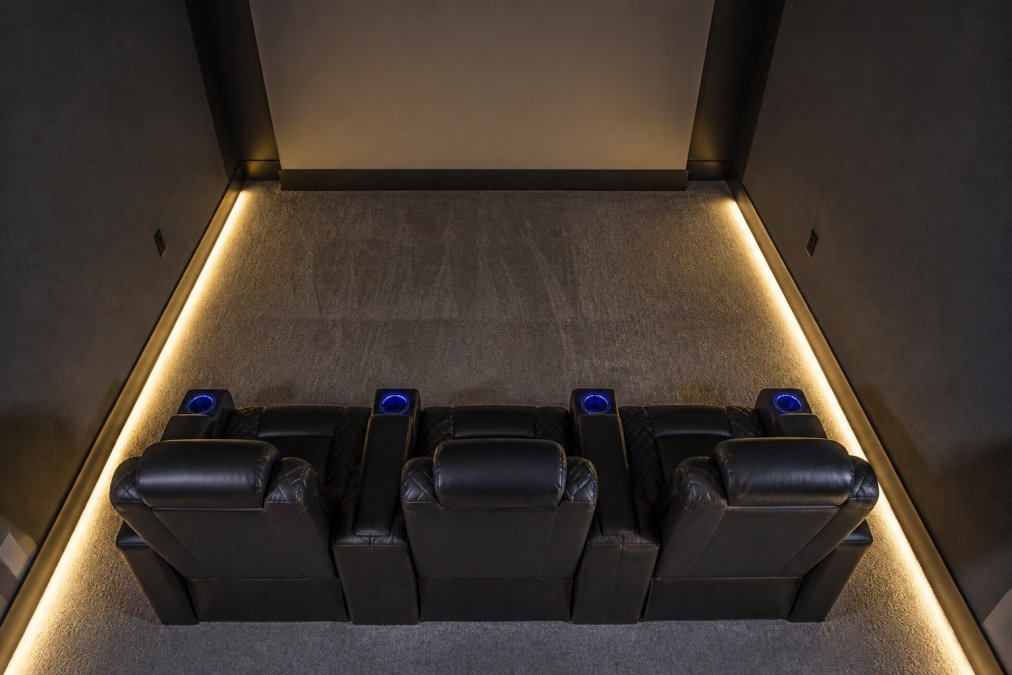
Calculating Viewing Distance and Walkway Clearance
Viewing distance is the horizontal measurement from your eyes (in the seated reclined position) to the screen surface. A comfortable viewing distance for a 65-inch screen is roughly 8-10 feet; for an 85-inch screen, 10-14 feet. Walkway clearance is the minimum aisle width needed to move comfortably in front of or behind the seating row, a workable minimum is 36 inches in front of the row and 18-24 inches behind.
For a single-row layout: measure the room depth from screen wall to rear wall, subtract your target viewing distance, subtract 36 inches for front walkway clearance, and the remaining depth is your available seat depth plus rear clearance. Wall-hugger recliners need 3-5 inches of rear clearance; standard recliners need 12-18 inches.
DIY Room Planning Tools to Visualize Your Setup
Before ordering, sketch your layout digitally. RoomSketcher's free floor plan tool lets you draw your room to scale, drop in furniture pieces with accurate dimensions, and view the result from above or in 3D. Confirm that every seat in the row has a clear, unobstructed view of the screen center.
Compact Home Theater Furniture: Features That Actually Matter
Not every feature listed in a product spec sheet changes the experience in a small room. Some do.
Ergonomics: Lumbar Support, Headrests, and Recline Angles
A seat that feels fine for 20 minutes can become genuinely uncomfortable at the 90-minute mark if lumbar support is inadequate or the headrest sits at the wrong height. Key specifications to check: lumbar support (adjustable is better than fixed), adjustable headrest (power-adjustable allows each viewer to set head position independently), recline angle (a full flat recline is the gold standard), and high-density foam. According to guidance from the American Chiropractic Association on sitting posture, supported lumbar positioning during extended seated periods significantly reduces lower back strain.
Upholstery and Fabric Maintenance in High-Traffic Small Rooms
Small rooms concentrate use. A media room that seats four people in a tight space gets more wear per square foot than a living room sofa.
Premium leather (as used in the Haiylee) is the most durable option. It resists moisture, cleans with a damp cloth, and develops a patina over time. Maintenance requires periodic conditioning roughly every 6-12 months. Vegan leather (used in the Ridgeline 5-Seat Set and USB & Storage Arm model) offers similar surface durability with easier initial cleaning. Faux leather (standard Ridgeline models) holds up well in normal use, wipe down seat surfaces after each use to prevent oil and moisture buildup.
For all three materials, avoid alcohol-based cleaners. A mild soap solution on a microfiber cloth handles most cleaning needs.
Which Seat Should You Pick? A Decision Framework
| Your Situation | Best Pick | Why |
|---|---|---|
| Solo viewer, small room | Ridgeline Single ($1,519.99) | Smallest footprint, full theater feel |
| Tech-forward, want charging built in | Ridgeline USB & Storage Arm ($1,739.99) | Eliminates need for side tables |
| Family of 4, dedicated media room | Ridgeline 4-Seat Set ($1,369.99) | Best per-seat value, 4 color options |
| Full home cinema, 5 viewers | Ridgeline 5-Seat Set ($1,939.99) | Full vegan leather row, individual recline |
| Maximum comfort, primary media room | Haiylee Zero Gravity ($2,474.54) | Top-grain leather, zero-gravity recline |
A few additional decision rules: If your room is under 120 square feet, stick to individual Ridgeline seats rather than the Haiylee sofa format for more layout control. If you're integrating with a projector setup, viewing distance from the seat to the screen is your primary layout constraint. If multiple people with different height preferences will use the same seat, prioritize the Haiylee's power-adjustable headrest or Ridgeline models with power recline. For multi-functional rooms, individual Ridgeline seats can be moved and rearranged; the Haiylee is better suited to a permanently dedicated viewing space.
Small rooms don't have to mean compromised seating. The right wall-hugger recliner, measured correctly and placed with walkway clearance in mind, delivers a genuine cinematic experience in spaces most guides would write off. JoeMo Promo's Ridgeline and Haiylee lineup covers every configuration from a single premium seat to a five-person dedicated theater row, with free shipping on most orders within the Continental U.S. and a 30-day return policy so you can order with confidence. Shop the Collection and find the seat that fits your room.
=== FAQ ANSWERS (audit these too, same rules) ===
[1] Q: Are wall-hugger recliners better for small rooms? A: Yes, for most small rooms they are the practical choice. A standard recliner needs 18 to 24 inches of clearance behind it to fully recline. A wall-hugger recliner slides the seat forward as the back drops, so it can sit as close as 4 to 6 inches from the wall and still reach a full recline position. That difference can free up enough floor space to add an extra row or simply keep walkway clearance safe and comfortable.
[2] Q: How much space do I need for luxury theater seating? A: Plan for at least 36 inches of walkway clearance in front of each row so people can pass without disturbing seated viewers. Each seat typically measures 33 to 36 inches wide. For viewing distance, a common guideline is 1.5 times the screen's diagonal measurement as a minimum distance from screen to seat. A room that is at least 10 feet wide and 12 feet deep can comfortably fit a single row of two to three compact theater recliners with adequate clearance.
[3] Q: What features should I look for in space-saving theater recliners? A: Focus on four things: a wall-hugger recline mechanism to minimize rear clearance, a narrow profile (under 36 inches wide per seat), high-density foam cushioning for long viewing sessions, and an adjustable headrest for ergonomic support. Built-in cup holders, USB charging ports, and storage arms add convenience without increasing the seat's footprint. Power recline is worth the upgrade over manual recline because it lets you stop at any angle, which matters when space behind the seat is limited.
[4] Q: How do you arrange seating in a small home theater? A: Start by measuring your room and marking the screen wall. Place your first row so the front of the seat sits at the correct viewing distance from the screen. Leave at least 36 inches between rows if you add a second row, and keep a 24-inch walkway along the sides. Push seats as close to the back wall as the recline mechanism allows. Use free online room-planning tools to sketch the layout before purchasing, so you can confirm sightlines and clearance on paper first.
[5] Q: What is the difference between power recline and manual recline for small rooms? A: Manual recline uses a lever or push-back motion and typically requires the seat to travel further backward to lock into position, demanding more rear clearance. Power recline uses a motor to move the footrest and backrest independently, stopping at any angle with the press of a button. For small rooms, power recline pairs best with a wall-hugger mechanism because the controlled, forward-sliding motion keeps the seat's rear footprint minimal even at full recline.
Frequently Asked Questions
Q: Are wall-hugger recliners better for small rooms?
A: Yes, for most small rooms they are the practical choice. A standard recliner needs 18 to 24 inches of clearance behind it to fully recline. A wall-hugger recliner slides the seat forward as the back drops, so it can sit as close as 4 to 6 inches from the wall and still reach a full recline position. That difference can free up enough floor space to add an extra row or simply keep walkway clearance safe and comfortable.
Q: How much space do I need for luxury theater seating?
A: Plan for at least 36 inches of walkway clearance in front of each row so people can pass without disturbing seated viewers. Each seat typically measures 33 to 36 inches wide. For viewing distance, a common guideline is 1.5 times the screen's diagonal measurement as a minimum distance from screen to seat. A room that is at least 10 feet wide and 12 feet deep can comfortably fit a single row of two to three compact theater recliners with adequate clearance.
Q: What features should I look for in space-saving theater recliners?
A: Focus on four things: a wall-hugger recline mechanism to minimize rear clearance, a narrow profile (under 36 inches wide per seat), high-density foam cushioning for long viewing sessions, and an adjustable headrest for ergonomic support. Built-in cup holders, USB charging ports, and storage arms add convenience without increasing the seat's footprint. Power recline is worth the upgrade over manual recline because it lets you stop at any angle, which matters when space behind the seat is limited.
Q: How do you arrange seating in a small home theater?
A: Start by measuring your room and marking the screen wall. Place your first row so the front of the seat sits at the correct viewing distance from the screen. Leave at least 36 inches between rows if you add a second row, and keep a 24-inch walkway along the sides. Push seats as close to the back wall as the recline mechanism allows. Use free online room-planning tools to sketch the layout before purchasing, so you can confirm sightlines and clearance on paper first.
Q: What is the difference between power recline and manual recline for small rooms?
A: Manual recline uses a lever or push-back motion and typically requires the seat to travel further backward to lock into position, demanding more rear clearance. Power recline uses a motor to move the footrest and backrest independently, stopping at any angle with the press of a button. For small rooms, power recline pairs best with a wall-hugger mechanism because the controlled, forward-sliding motion keeps the seat's rear footprint minimal even at full recline.
This article was written using GrandRanker