Luxury Home Theater Seating: The Complete Comfort Guide
Table of Contents
- Why Home Theater Seating Comfort Matters More Than You Think
- Types of Luxury Home Theater Seating: Which Setup Fits Your Space
- Best Home Theater Seating for Small Spaces
- Ergonomic Features of Luxury Theater Chairs
- Home Theater Seating Spacing Requirements and Room Layout
- Materials: Leather vs. Fabric and Durability Considerations
- Power Recline, Zero-Gravity, and Advanced Comfort Features
- Acoustic Impact and Accessibility in Theater Seating Design
- Frequently Asked Questions
Last Updated: September 3, 2026
Why Home Theater Seating Comfort Matters More Than You Think
The difference between a forgettable movie night and an unforgettable one often comes down to where you're sitting. When your back aches 20 minutes into a film, even the best cinematography fades into the background. Home theater seating comfort is not a luxury add-on, it's the foundation of a cinematic experience that keeps you engaged for the full runtime.
Luxury theater seating combines ergonomic engineering, premium materials, and mechanical innovation to support your body in ways standard furniture cannot. When you recline in a properly designed theater chair, your spine aligns naturally, pressure points distribute evenly across high-density foam, and your legs elevate to promote circulation. This guide explores every element of luxury home theater seating so you can transform your viewing space into a true private cinema.
Types of Luxury Home Theater Seating: Which Setup Fits Your Space
Choosing the right configuration shapes your entire theater room. The two primary approaches, power recliners versus fixed seating, and individual seats versus sectional layouts, each offer distinct advantages depending on your space and viewing priorities.
Power Recliners vs. Fixed Seating
Power recliners allow you to adjust your position throughout a film, letting you sit upright during dialogue-heavy scenes and fully recline during action sequences. Quality models include independent headrest and footrest adjustments for different body types and preferences.
Fixed seating appeals to homeowners prioritizing durability and simplicity. These chairs don't require electrical connections or mechanical maintenance and often cost less upfront. However, they force you into a static posture for the entire viewing session, which can lead to discomfort during longer movies. If you're building a dedicated media room where people will spend hours at a time, power recline is worth the investment.
Sectional vs. Individual Seats
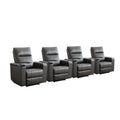
Sectional theater seating creates a unified, couch-like experience where multiple people sit in one continuous piece. Individual power recliners give each person complete autonomy over their recline angle, headrest position, and footrest extension. One viewer might want full recline while another prefers sitting upright. Individual seats also eliminate the problem of one person's movement jostling their neighbor.
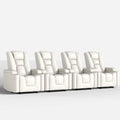
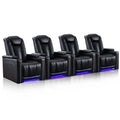
The Ridgeline 5-Seat Power Theater Recliner Set exemplifies the individual approach, offering five independent recliners in vegan leather with individual cup holders so no one reaches across the row during crucial scenes.

Best Home Theater Seating for Small Spaces
Small rooms present a genuine constraint: oversized sectionals and sprawling recliner arrays simply don't fit. Start by measuring your room depth and width, then work backward from viewing distance. A 12-foot-deep room can accommodate a single power recliner or a pair of seats, but not a five-seat configuration.
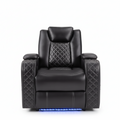
The Ridgeline Single Power Theater Recliner is purpose-built for tight quarters. At 35.4 inches wide with full power recline, a motorized footrest, and a cup holder, it fits comfortably in rooms where a sectional would dominate. For couples or small households, two individual recliners positioned side-by-side work better than a two-seat sectional, giving each person independent control.

Ergonomic Features of Luxury Theater Chairs
Comfort in theater seating comes from specific engineering choices. The difference between a chair that feels good for 30 minutes and one that supports you for three hours lies in lumbar support, headrest design, foam quality, and seat depth.
Lumbar Support and Backrest Design
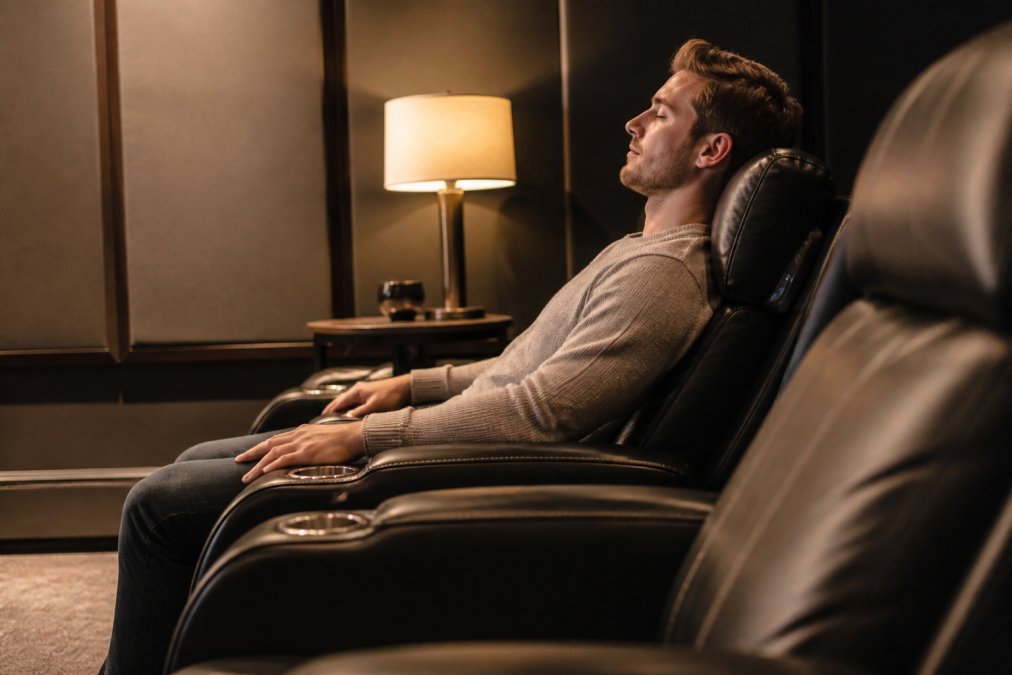
Your lower back bears the most stress during extended sitting. A properly designed backrest includes built-in lumbar support, a subtle curve that maintains the natural inward curve of your spine. High-end theater chairs feature adjustable lumbar support, allowing you to dial in the exact level of curvature that matches your spine's geometry. The backrest height should extend at least to your mid-back, ideally reaching your shoulder blades.
Headrest Adjustment and Neck Support
Your neck is the most vulnerable part during extended viewing. Adjustable headrests let you raise, lower, or tilt the support to match your head size and preferred recline angle. The best theater chairs include motorized headrest adjustment synchronized with the recline mechanism, maintaining proper neck alignment as you recline.
High-Density Foam and Seat Depth
Premium theater chairs use 2.5-3.0 pound-per-cubic-foot foam, which resists compression and maintains its shape through years of use (astm.org). Seat depth should accommodate your thigh length without pressing into the back of your knees. Luxury recliners typically offer 22-26 inches of seat depth, which works for most body types.
Home Theater Seating Spacing Requirements and Room Layout
The optimal viewing distance from your screen is 1.5 to 2.5 times the screen's diagonal width (smpte.org). For a 100-inch screen, sit 12.5 to 20 feet away. Arrange seating so the center of each chair's sightline points directly at the screen's center. Allow at least 18 inches between the armrest of one chair and the next for comfortable movement.
Position the back row at least 3 feet behind the front, and ensure back-row viewers can see over the front-row headrests. Stagger seating in an offset pattern if possible, with back-row seats positioned between front-row seats, to maximize sightlines and create a more authentic theater layout.
Materials: Leather vs. Fabric and Durability Considerations
Material choice affects both aesthetics and long-term durability. The two primary options, genuine leather and fabric, each have distinct advantages and maintenance requirements.
Top-Grain Leather: Premium Look and Maintenance
Top-grain leather delivers a luxury appearance and feels premium to the touch. It's durable and develops a patina over time while resisting staining better than fabric. However, leather requires regular maintenance, spills need immediate blotting, and the material needs periodic conditioning to prevent cracking and fading.
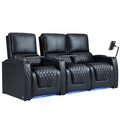
The Haiylee Zero Gravity Theater Sofa uses top-grain leather, combining premium aesthetics with engineered wood frame construction and power headrest and footrest. Top-grain leather works best in dedicated media rooms where you control the environment. It costs more upfront but lasts longer if properly maintained.

Vegan Leather and Faux Leather: Practical Alternatives
Vegan leather and faux leather offer the visual appearance of genuine leather without the maintenance burden. These synthetic materials resist staining, don't require conditioning, and clean easily with a damp cloth. They're more affordable than top-grain leather and hold up well in households with children or pets.
The Ridgeline 5-Seat Power Theater Recliner Set and Ridgeline Single Power Theater Recliner both feature vegan leather, offering a practical balance of durability, ease of maintenance, and cost-effectiveness.
Long-Term Durability of High-End Mechanisms
Power recline mechanisms are the most complex components of luxury theater seating. A quality motor and drive system should operate smoothly for 10,000+ cycles (roughly 15-20 years of regular use). Inspect the frame construction too, solid wood or engineered wood frames outlast particle board. The best theater chairs use hardwood frames with corner blocks and dowel reinforcement.
Premium recliners typically include 3-5 year warranties on the motor and frame. Read the fine print carefully, as some warranties cover only defects, not wear-and-tear.
Power Recline, Zero-Gravity, and Advanced Comfort Features
Modern luxury theater seating goes beyond simple recline with advanced mechanisms and positioning options.
How Power Recline Improves the Viewing Experience
Power recline lets you adjust your position without disrupting others or losing focus on the screen. A quality motor operates silently and moves smoothly through the full range of motion. The best systems include infinite-position stops, meaning you can pause at any angle rather than just a few preset positions. During a three-hour movie marathon, the ability to adjust your position halfway through makes the difference between a pleasant evening and physical discomfort.
Zero-Gravity Positioning and Its Health Benefits
Zero-gravity positioning elevates your legs above heart level while your torso reclines at approximately 130 degrees (peer-reviewed research). This position distributes your body weight evenly, reduces pressure on your spine, and improves circulation. The Haiylee Zero Gravity Theater Sofa delivers this positioning with motorized headrest and footrest, allowing you to find the exact angle that feels best for your body. Your spine decompresses slightly, intervertebral discs reabsorb fluid, and muscles relax more completely than in traditional recline. If you spend four or more hours per week in your theater seating, zero-gravity is worth prioritizing.
Motorized Headrests, Footrests, and Cup Holders
Motorized headrests adjust independently of the recline mechanism, letting you fine-tune neck support as you change position. A footrest extension should raise your legs to approximately the same height as your heart, promoting circulation and reducing swelling. Dual cup holders, one on each armrest, eliminate the need to lean across or interrupt your viewing.
Acoustic Impact and Accessibility in Theater Seating Design
Seating materials influence room acoustics in ways most people overlook. Leather reflects more sound than fabric, which can create slight echo in the high frequencies. Fabric absorbs sound, slightly warming the acoustic profile. In rooms with hard walls and minimal soft furnishings, leather seating can contribute to a slightly harsh acoustic character. Adding fabric elements, throw pillows, area rugs, or wall treatments balances this.
Accessibility is equally important. Theater seating should accommodate users of different body types, mobility levels, and physical abilities. Power recline is inherently more accessible than manual lever systems, requiring less physical effort. Seats with armrests that don't obstruct entry are easier for users with limited mobility. If anyone in your household has mobility limitations, power recline and accessible entry become non-negotiable.
Building the perfect home theater means balancing comfort, durability, and room layout into a cohesive system. JoeMo Promo's curated selection of luxury theater seating, including the Haiylee Zero Gravity Theater Sofa and Ridgeline Power Recliner series, combines ergonomic engineering with premium materials to deliver the cinematic comfort you deserve. Start by measuring your space, identifying your priorities (power recline, zero-gravity positioning, material preferences), and selecting seating that matches your actual usage patterns. Shop the collection at JoeMo Promo and transform your room into a genuine private cinema where comfort never compromises the experience.
Frequently Asked Questions
What makes luxury home theater seating different from a regular couch?
Luxury home theater seating is engineered specifically for extended viewing sessions. It features high-density foam that maintains support over time, ergonomic lumbar and cervical support, power recline mechanisms with precise angle control, and materials like top-grain leather designed for durability and comfort. Regular couches prioritize general seating; theater seats prioritize the cinematic experience and physical support during hours-long movie marathons.
How do I choose the best home theater seating for small spaces?
In compact rooms, prioritize individual power recliners over sectionals, they offer flexibility in arrangement and take up less visual space. Look for seats with a narrower seat depth (around 30-35 inches) and compact footrests that don't extend far when reclined. Consider wall-hugging recliners that don't require clearance behind them. Measure your room's depth and width carefully, and ensure at least 12-18 inches of space between the front of the seat and a wall or table.
Are motorized headrests and footrests necessary for comfort?
Motorized headrests and footrests significantly enhance comfort for extended viewing, especially for people with neck or lower back concerns. Power headrests allow precise angle adjustment without manual repositioning, while motorized footrests extend smoothly and support proper leg elevation. However, they're not essential, fixed headrests and manual recline work fine for casual viewing. If you watch movies frequently or have mobility concerns, the motorized features justify the investment.
What's the ideal viewing distance and seat arrangement for a home theater?
The golden rule is to sit 1.5 to 2.5 times the screen's diagonal width away. For a 100-inch screen, that's 12.5 to 20 feet. Arrange seats in a slight arc or stadium-style configuration so viewers in back rows have clear sightlines over front seats. Allow 18-24 inches of width per seat and 3-4 feet of legroom between rows. Proper spacing prevents neck strain and ensures everyone sees the screen comfortably without obstruction.
Should I choose leather or fabric for my theater seating?
Top-grain leather offers a premium look, durability, and easy cleaning, ideal for high-use rooms. It does require occasional conditioning and can feel warm. Vegan leather and faux leather provide similar aesthetics with easier maintenance and better temperature regulation. Fabric options are softer and warmer but require more frequent cleaning. For long-term durability in a dedicated media room, top-grain leather or quality vegan leather outperforms fabric, especially in homes with pets or children.
How does zero-gravity seating improve the home theater experience?
Zero-gravity positioning reclines the seat so your legs elevate to heart level, distributing your weight evenly and reducing pressure on the spine. This position improves blood circulation, reduces back strain during long viewing sessions, and creates a deeply relaxed state ideal for immersive movie watching. The Haiylee Zero Gravity Theater Sofa, for example, uses this mechanism with a solid-engineered wood frame and power headrest to deliver both comfort and support over extended use.
What acoustic properties should I consider when selecting theater seating?
Seating materials affect room acoustics significantly. Leather and vegan leather reflect sound, which can enhance surround audio clarity but may create slight echoes. High-density foam in seats absorbs some mid-range frequencies. For optimal acoustic performance, pair seating with acoustic panels or bass traps elsewhere in the room. Avoid overstuffed seats that absorb too much sound, as they can muffle dialogue and immersive audio effects that make home theater special.
This article was written using GrandRanker