4Seating vs Theater Seat Store: Which Is Better?
Table of Contents
- 4Seating vs Theater Seat Store: Quick Comparison
- Price and Value: What You Actually Get
- Materials and Build Quality: Leather, Foam, and Frames
- Power Features: Headrests, Lumbar Support, and Recline
- Customization and Configuration Options Compared
- Warranty, Shipping, and Customer Service
- Best Home Theater Seating for Small Spaces
- Home Theater Seating Buying Guide: How to Choose
- Frequently Asked Questions
Last Updated: September 6, 2026
4Seating vs Theater Seat Store: Quick Comparison
Choosing between 4Seating vs Theater Seat Store comes down to one question: a la carte customization or a ready-to-ship set that works today? For most homeowners building a dedicated media room, the practical answer favors retailers offering complete, coordinated seating packages with transparent pricing.
One approach lets you configure every inch of a seat, often at a premium with longer lead times; the other focuses on pre-configured sets that deliver immediate value.
| Comparison Factor | 4Seating-Style Custom Builders | Ready-to-Ship Sets (JoeMo Promo) |
|---|---|---|
| Customization | Extensive (fabric, width, row config) | Color and set size options |
| Lead Time | Often weeks for custom builds | Ships quickly, ready for setup |
| Price Transparency | Quotes vary by configuration | Fixed, listed prices |
| Best For | Complex, multi-row stadium layouts | Standard media rooms and quick upgrades |
Price and Value: What You Actually Get
Custom builders start with a base price and add costs for every upgrade: power headrests, lumbar systems, leather grades, and accessory mounts. A single seat can climb quickly before row configuration fees.
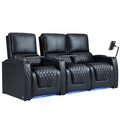
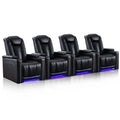
Ready-to-ship alternatives bundle those features into a single, fixed price. For example, a full five-seat power recliner set with cup holders and vegan leather is available for $1,939.99, which breaks down to roughly $388 per seat. That price includes power recline, individual seating, and dedicated cup holders without hidden configuration surcharges.

A custom-configured row can easily exceed the cost of a complete, ready-to-install set. For buyers who prioritize a clear budget and a fast path to movie night, fixed pricing wins.
Materials and Build Quality: Leather, Foam, and Frames
The real test of home theater seating is what happens after 12 months of weekend movie marathons, spilled soda, and daily reclining. This section provides a technical specification matrix for long-term durability.
Upholstery Grades: Beyond the "Genuine Leather" Trap
The term "genuine leather" is one of the most misleading labels in furniture; it refers to the lowest grade of split hide. The hierarchy, from lowest to highest, is: bonded leather, genuine leather, top-grain leather, and full-grain leather. Custom builders often upsell from bonded to top-grain, with a price jump of 40% or more per seat.
Ready-to-ship sets like the Ridgeline line from JoeMo Promo use a high-grade vegan leather, a polyurethane (PU) coating over a polyester backing. The key spec is abrasion resistance, measured by the Wyzenbeek test (double rubs); residential-grade fabric should withstand 15,000 to 30,000 double rubs, and the Ridgeline upholstery is engineered to exceed that threshold. Low-quality bonded leather will start flaking at the seams within 18 to 24 months.
Foam Density and Frame Construction: The Real Predictors of Lifespan
The American Home Furnishings Alliance guidelines point to two factors as the best predictors of a sofa's lifespan: foam density and frame joinery. Foam density is measured in pounds per cubic foot (lbs/ft³); low-end furniture uses foam at 1.5 to 1.8 lbs/ft³, which loses resilience within a year, while quality seating uses foam in the 2.0 to 2.5 lbs/ft³ range.
Frame construction is equally critical. The cheapest frames use particleboard or stapled softwood; a durable frame uses kiln-dried hardwood with reinforced corner blocks and doweled or screwed joinery. The Haiylee Zero Gravity Theater Sofa uses a solid and engineered wood frame for the rigidity needed for the zero-gravity recline mechanism.
The 12-Month Wear-and-Tear Checklist
When you are comparing a custom builder against a ready-to-ship set, ask these specific questions to project long-term performance:
- What is the exact foam density in the seat and back cushions? If the salesperson cannot answer, assume it is below 1.8 lbs/ft³.
- What is the abrasion rating of the upholstery? Look for a Wyzenbeek score of 30,000 double rubs for residential use.
- What type of frame joinery is used? Doweled and glued hardwood beats stapled softwood every time.
- Is the reclining mechanism rated for daily use? Ask about the motor's duty cycle and the warranty on the moving parts.
The Unique Angle: A Data-Driven Comparison
By asking for foam density, abrasion rating, and frame joinery specs, you can compare a $400 per-seat ready-to-ship set against a $900 per-seat custom build on objective terms. In many cases, the premium custom build uses the same grade of foam and a similar synthetic leather.
A high-quality vegan leather with a 2.0+ lbs/ft³ foam core and a hardwood frame will outlast a low-grade bonded leather with soft foam, regardless of whether the latter is labeled "genuine leather." Prioritize specs over labels to avoid common durability pitfalls.

Power Features: Headrests, Lumbar Support, and Recline
Power features are now standard for comfortable home cinema setups. The most sought-after functions include power headrests, adjustable lumbar support, and smooth recline mechanisms; custom builders let you spec each individually, but it adds cost and complexity.
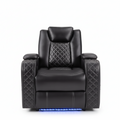
Ready-to-ship power recliners bundle these features into the base design. The Ridgeline Power Recliner with USB and Storage Arm adds built-in USB charging and dual cup holders alongside the power recline.

For most media rooms, a set with power recline, a power headrest, and lumbar support as standard equipment offers the best value, avoiding the per-feature markup custom builders apply.
Customization and Configuration Options Compared
This is where custom builders hold a genuine advantage. If you need a curved row, a specific seat width for an unusual space, or a mixed configuration of loveseats and singles, a custom builder is the necessary route.
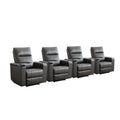
That flexibility comes with trade-offs: custom orders require longer lead times, and the final price can be opaque until you finalize every detail. For most homeowners with a standard rectangular media room, pre-configured sets offer sufficient flexibility; the Ridgeline 4-Seat Power Recliner Set comes in gray, beige, black, or brown.
If your room has unusual dimensions or you are building a dedicated multi-row theater with risers, plan for a custom quote. If you have a standard space and want a coordinated look with minimal hassle, a complete set delivers the best balance.
Warranty, Shipping, and Customer Service
Support structures differ significantly between the two models. Custom builders often provide detailed warranties on specific components, but the onus is on you to track which part is covered by which clause, and shipping logistics for large, custom-built rows can be complex.
Retailers offering ready-to-ship sets typically simplify this process. JoeMo Promo provides free shipping on most orders within the Continental U.S. Their 30-day return policy offers a safety net custom builders rarely match, given that custom items are usually non-returnable.
Customer support responsiveness is another differentiator; a dedicated team that can answer questions about assembly and return authorization before you buy is invaluable.
Best Home Theater Seating for Small Spaces
Selecting the best home theater seating for small spaces is about calculating your room's geometry so every seat delivers a clear sightline and comfortable recline clearance.
The Three Critical Measurements
Before you look at any product, measure three things in your room:
- Wall-to-wall depth: This determines whether you can use a wall-hugger mechanism or need a traditional recliner with more clearance.
- Row width: This dictates the maximum number of seats you can fit side-by-side.
- Ceiling height and riser depth: If you are planning a second row, you need to calculate the riser height to maintain a clear sightline over the front row.
For a single row in a room under 12 feet deep, a wall-hugger design is essential. A standard recliner needs 12 to 18 inches of clearance behind it to fully recline, while a wall-hugger mechanism slides the seat forward, requiring only 2 to 4 inches of wall clearance, saving up to 14 inches of floor depth.
Row Spacing and Sightline Calculations
For a dedicated media room with two rows, place the front row at a distance of 1.5 to 2.5 times the screen width, and the second row on a riser. A common pattern is to raise the second row by 12 inches for every 6 feet of distance from the front row.
Here is a practical checklist for a two-row setup:
- Front row distance from screen: 1.5 to 2.5 times the screen's diagonal width.
- Back row distance from screen: Add 4 to 5 feet to the front row distance.
- Riser height: 12 inches for the first 6 feet of row separation, then add 6 inches for each additional 3 feet.
- Row width: Subtract 6 inches from the room's width to account for wall trim and speaker placement, then divide by the seat width (typically 20 to 24 inches) to get the maximum seat count.
Modular Flexibility: Start Small, Expand Later
For compact media rooms, a modular approach is the most practical strategy. Instead of committing to a five-seat row that may overwhelm the space, start with two single seats; the Ridgeline Single Power Theater Recliner delivers the full theater experience, power recline, cup holder, and USB charging, in a footprint that fits a home office conversion or bedroom setup.

A modular setup also lets you test the layout before expanding. Place the two singles at the correct distance from the screen, use them for a few weeks, and then decide whether you have room for a third or fourth seat.
The Spatial Planning Advantage
Most vendor comparisons stop at product dimensions. By applying the calculations above, you can determine whether a ready-to-ship set like the Ridgeline 4-Seat Power Recliner Set will fit your space.
For example, a 10-foot-deep room with an 8-foot-wide screen can comfortably fit a three-seat row of 22-inch-wide recliners, leaving 6 inches of clearance on each side. The same room cannot accommodate a five-seat row without pushing seats into the side walls and blocking speaker placement.
Final Check for Compact Layouts
Before finalizing any purchase for a small space, run this final checklist:
- Confirm the fully reclined length of the seat fits within the room's depth.
- Verify the seat width allows at least 2 inches of clearance between armrests.
- Check that the recline mechanism does not require side clearance for the footrest extension.
- Ensure the power cord can reach an outlet without creating a trip hazard.
Home Theater Seating Buying Guide: How to Choose
This home theater seating buying guide distills the decision into a few key checks. Before comparing specific models, measure your space and define your viewing distance.
Use this checklist to evaluate your options:
- Measure the room's width and depth to determine the maximum row length.
- Confirm the seat width fits your family's needs; standard widths range from 20 to 24 inches.
- Check the recline mechanism type and whether the seat requires clearance from the wall.
- Decide on power features: prioritize power headrest and lumbar support for long viewing sessions.
- Select upholstery based on durability and maintenance, not just initial appearance.
- Verify the weight capacity and frame construction for long-term reliability.
- Review the warranty coverage and return policy before finalizing your purchase.
When comparing how to choose home theater recliners, the primary question is whether you need custom dimensions. If your answer is no, a ready-to-ship set from a retailer like JoeMo Promo offers superior value, faster delivery, and a simpler support experience. The American Home Furnishings Alliance guidelines on furniture durability suggest that frame construction and foam density are the best predictors of a sofa's lifespan, reinforcing the importance of checking those specs over brand names.
For those with a clear budget and a standard layout, the Ridgeline 5-Seat Power Theater Recliner Set at $1,939.99 is the optimal choice for a dedicated media room. It provides a complete solution without the complexity of a custom build. The Consumer Reports guidance on recliner purchases echoes this sentiment, noting that buyers often overpay for features they do not use.
Ultimately, the best choice depends on your room's constraints and your tolerance for project management. If you want a turnkey upgrade that works this weekend, prioritize the ready-to-ship sets. If you are building a complex, multi-row home cinema setup with specific ergonomic needs, then exploring a custom quote is the right path. The Home Theater Design guidelines on seating layout recommends planning your seating row first, as it dictates the screen height and speaker placement for the entire room.
Choosing the right seating comes down to matching the product to your space and your tolerance for lead times. For most homeowners, the complexity and cost of a fully custom order is unnecessary when high-quality, power-reclining sets are available with transparent pricing and fast shipping. JoeMo Promo offers a handpicked selection of Ridgeline and Haiylee seating that balances comfort, durability, and value, backed by free shipping on most orders within the Continental U.S. and a 30-day return policy.
Frequently Asked Questions
Is 4Seating a reputable company?
4Seating has operated for years and maintains a strong catalog of home theater furniture. However, customer reviews show mixed experiences with shipping delays and post-purchase support. Look for current reviews on independent platforms to gauge recent performance, and always confirm exact delivery lead times before ordering.
What are the main differences between 4Seating and Theater Seat Store?
The main differences come down to brand focus and pricing structure. 4Seating sells multiple brands with a wide customization range, while Theater Seat Store often emphasizes its own branded builds. The 4Seating vs Theater Seat Store comparison also shows differences in lead times, with custom orders from either taking several weeks to arrive.
How do I choose home theater recliners for a small media room?
Measure your room's depth first, then subtract 36 inches for the recline clearance. Look for wall-hugger designs that slide forward instead of back, which lets you place seats closer to the wall. A single row of seats with individual cup holders usually fits rooms under 12 feet deep. Prioritize seat width over armrest width, and check the weight capacity to confirm the frame suits your household.
Which retailer offers a better warranty on home theater seating?
Warranty terms differ per brand and product line, not just per retailer. Some manufacturers cover frames and mechanisms for three years while limiting upholstery coverage to one year. Confirm whether the warranty covers parts, labor, or both, and clarify the return authorization process for defective items.